Tuesday, 27 November 2012

November 5, Monday

November 5, Monday

I did not have to get up early today, so I lazed around the apartment until about 11 am and then went out with the intention of walking downtown to see the Fjordland Film and then take the cruise to the Glow-worm caves on Lake Te Anau (which is actually Te Anaua but the Kiwis have reduced it).  I had only walked half way down Quintin Drive when I decided it was too cold for a walk and went back to get the car.
After driving around getting the lay of the land and finding a parking stop close to the theatre, I went it to see “Fjordland on Fim”, which plays every hour on the hour.  I was the only person in the small theater, so I could OOH and AAH as much as I pleased without disturbing anyone.   “Filmed by award winning cinematographers” there is no voice over, just beautiful scenes and a musical composition playing in the background.  “The creators of ‘Ata Whenua – Shadowland’ have lived and worked in the area for over 25 years.  Their wish is that Fiordland remains as wild and pristine as it is today.”  The film takes us through the seasons over the fjordlands, showing ice covered mountains, clear water falls, mountain forests covered in moss, sheer granite cliffs, the fjords of course as well as the coast.  Everything has been filmed from helicopters and you feel like the passenger flying over all of these amazing spaces. 

The film is about 35 minutes long, so I had plenty of time to get back in the car for the short drive to the lakeshore marina to pay for my pre-booked cruise.  The cruise left on time with quite a few passengers on board, but it was almost impossible to take pictures through the thick windows.  At one point the ship did slow down for a shallow portion and we were able to go outside to snap some photos.
 Lake Te Anau and the cruise ship to the Glow worm caves
Lake Te Anau is the largest lake in the South Island and the second biggest lake in New Zealand (after Lake Taupo on the North Island).

Paua Shells:    I purchased some earrings made of Paua Shells before arriving in Dunedin, as well as a cute little ring with a paua shell mounted in a silver square. Yesterday evening, as I was taking the ring off I was surprised to see something strange on the ring and wondered why the middle section was thicker. Today I finally realized that I had lost the square silver mounted Paua shell and what was left on the ring was the welding mark. CRAP ! Oh Well…. At least I still have the earings.

Views from the cruise on Lake Te Anau

 It is a very gloomy day so it makes for grey photos

 As we approach the landing area I get a better view of the surrounding forests.  Looks a lot like ours.

Landing on the western shore of Lake Te Anau to visit the Glow-worm caves:  They are famous for their beautiful water-formed rock sculptures and formations, their rushing white water and whirlpools and their magical glow-worms.   
 “The caves are part of a 6.7 km, four-level limestone labyrinth known as the Aurora Caves system. They are about 12,000 years old, which is young in geological terms, but the limestone they carve through is ancient, up to 35 million years old.  Unlike many dry cave systems, Te Anau Glowworm Caves are still increasing in size.  The “tunnel burn” that flows through the caves is mildly acidic, which helps the water dissolve the rock and create passages.” 
We entered the caves through a narrow low opening, requiring that we crouch down to get in.  The lighting was very poor and my night vision is not the best so I had to keep hold of the handrails all the way through.  When we were not walking on a cave floor, we were on an elevated metal walkway with roaring waters under our feet.  There was water dripping from the walls and ceilings and I was glad I had thought of wearing my gloves and my rain cape.  We walked a good distance within the cave, up and down staircases until we reached a boat in calmer waters, and got in almost in total darkness.  The boat is moored to some type of pully system and our guide pulled us through the waters until we reached an area where we could see the glow worms.
We were not allowed to take pictures within the cave, and in any case most of the time it was much too dark anyway.   Here is a picture I took later on during my trip, in a museum, where they had simulated what it looked like.

  Tiny pin-pricks of light on the cave ceilings.   Kind of looks like a "starry, starry night"

After the tour of the caves we had a few minutes to walk along a nearby trail and see the surrounding woods.
Snug in my "I walked the Great Wall of China" fleece.
We were then given access to tea, coffee or hot chocolate while we watched a film that explained the short life span of a glow-worm.  Industrious little buggers.
When we got back to Te Anau I decided to find a restaurant for dinner even though it was not yet 5 pm.  I decided I was in the mood for some Italian food and there were two advertised on the tourist map I was using.  The first one I located was a pizzeria called “La Toscana”, which was closed; the second one just down the street “CafĂ© La Dolce Vita” was closed as well, but they at least had a sign indicating that they did not open until 6 pm.  Since I was really hungry (breakfast had been at 9 am and I had not eaten since) I decided to try my luck with ANY open restaurant.  Well they must have some type of deal with each other because every single restaurant I passed was closed.  Either that or they have day jobs and a separate business to run in the evening.  I had seen a grocery store near the Theatre, so I headed for that thinking of just buying a few supplies for the motel room and my little cooler, killing time before the restaurants opened.  Turns out they had a really nice selection of ready-made food, including some “chicken & cashew” tortellini.  Back to the Italian option as you can see.  I found some nice 3-cheese sauce to go with that and a “pesto and cashew” dip that I could incorporate into the sauce for some additional flavour.  Grab a bottle of wine and a few buns and my meal was almost ready.  I returned to the car, drove back to the motel and fixed myself a DELICIOUS meal, if I do say so myself.  That glass of Sauvignon Blanc was just perfect to go with my meal.

November 4, Sunday

November 4, Sunday

Drove from Dunedin to Te Anau, only about 290 km, but a beautiful drive first along Highway 1 to Balclutha and then west across the tip of the South Island to the town of Gore.  It is a beautiful sunny day.  A lot of sheep in the fields and since it is spring A LOT OF LITTLE LAMBS.  They are so cute.   I even saw some jumping straight up into the air, just like in the cartoons.   Some were tiny new born babies but others were almost the size of their mothers.  Lots of twins and even some triplets; they are easy to spot since they stick close to mama and don’t wander off very far.
 Just outside Dunedin, a nice divided highway

 that quickly changed to a regular road, but the beautiful rolling hills provided miles of vistas.

 And it was a beautiful sunny day, with all shades of green and blue

 
 Arriving in Gore, must be famous for its fishing.
Since it was Sunday and I hadn’t eaten a good meal in quite while, I decided to stop in the small town of Gore where I found a nice restaurant open and filled with locals. I was hoping to get some nice roast beef, but the specials for the day were roast pork or roast….. lamb !  


I felt like I was the BIG BAD WOLF, but I ordered the lamb…. And it was SO GOOD; the most tender meat I’ve eaten in ages... Maybe ever!

 The road continued to provide beautiful changing sights.

 And the snow capped mountains got closer and closer

 
It was only about one hour more to Te Anau on highway 94 and the fields were still filled with sheep, cows and deer.  

 Yes, deer.  I found out that they raise them and sell the meat to Asia and, of all places, Germany.

Listened to the radio a lot today and can’t help but laugh at the Kiwi accent, but I have to hurry and say it’s not all kiwis who use this pronunciation.  It’s not a bedroom, it’s a beed-room.  It’s not seven, it’s see-ven. There were a few other words I’ll try to remember and add in my notes.  I do take pictures while I drive, but you will be happy to know that I don’t try to jot down notes.
As I near Te Anau and the surrounding mountains, the clouds get heavier and darker.
I found the Anchorage Motel very easily since Te Anau is just a small town.  The manager at the motel wasn’t the most talkative and seemed a bit dour, but he did help me with my tourist tours, explaining about a few things I could do the next day on my own and arrange for my tour to Milford Sound the following day. 

 Living room

 Main beedroom

and kitchenette.   That little blue cooler has helped me keep beverages and butter nice and cool with the ice packs.
My room at the motel is actually a small two bedroom apartment (one with a queen size bed and the other with two bunk beds.  The living room has two small sofa beds as well as a tiny table with two chairs.  The kitchenette was also tiny, but functional. 

During the evening I heard fireworks.  Turns out it is Guy Fawkes day.  Who was Guy Fawkes?  All bomb techs know.  He is the man who tried to blow up the London Parliament Buildings in 1605.   When I worked at the Canadian Police College, I found out about him because the bomb guys used his identity as a kind of mascot.      “Guy Fawkes was a member of a group of provincial English Catholics who planned the failed Gunpowder Plot of 1605. They planned to assassinate King James I and restore a Catholic monarch to the throne. The plotters secured the lease to an undercroft beneath the House of Lords, and Fawkes was placed in charge of the gunpowder they stockpiled there. Prompted by the receipt of an anonymous letter, the authorities searched Westminster Palace during the early hours of 5 November, and found Fawkes guarding the explosives. Over the next few days, he was questioned and tortured, and eventually he broke. Immediately before his execution on 31 January, Fawkes jumped from the scaffold where he was to be hanged and broke his neck, thus avoiding the agony of the mutilation that followed. Fawkes became synonymous with the Gunpowder Plot, the failure of which has been commemorated in England since 5 November 1605. His effigy is traditionally burned on a bonfire, commonly accompanied by a firework display.”
It was a Church of England thing to begin with, now it’s just an excuse to party and have a great big bonfire.  And yes, I know, it’s only November 4rth, but tomorrow is a Monday so I guess they celebrate on the nearest weekend night.

Wednesday, 21 November 2012

November 3, Saturday

November 3, Saturday

Got a late start this morning.  It was really cold in the unit and it was still raining outside.  I read and slept until about 11 am and then decided to get my butt in gear and go out to explore the Otago Peninsula.
 Leaving Dunedin and driving up into the mountains of the Otago Peninsula

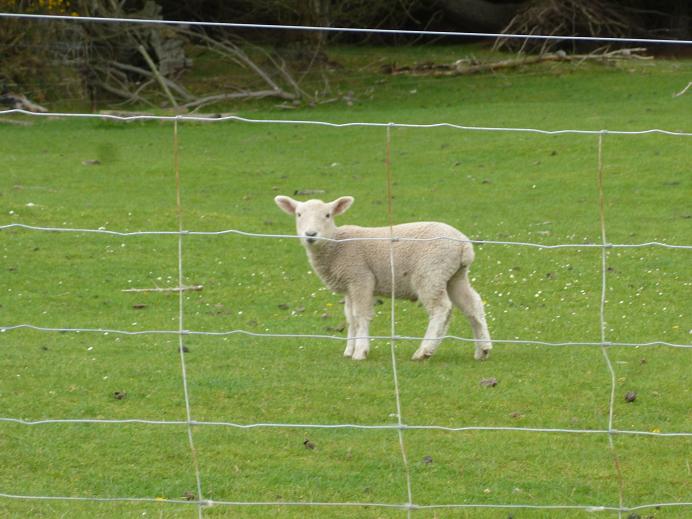
Lots of pasture lands.  I stopped to snap a photo of this young lamb.  Not a baby, a bit older.

I stopped at a lookout to snap this picture of the peninsular and Otago Harbour

Drove up to the high hills on the upper road. Stopped to visit Larnach Castle, the only one in New Zealand

 "The Larnach Castle gardens are one of only five gardens nationwide to have been given the rating of 'Garden of International Significance' by the New Zealand Gardens Trust.  They were the first gardens in the South Island to be given this award.  The house was built between 1871 and 1887 as the residence of William Larnach, a prominent entrepreneur and politician in colonial New Zealand. The resulting complex eventually contained 43 rooms and a ballroom and required a staff of 46 servants. The ballroom was built as a 21st birthday present for Larnach's favourite daughter Kate in 1887.  The building, which Larnach himself simply called "The Camp," did not ensure his happiness. After many years in which the place fell into disrepair, it was bought by Barry and Margaret Barker in 1967 and has been restored. It affords spectacular views of the Otago Peninsula and Harbour and is 10 kilometres by road from the city centre."

 No photography was allowed inside the house, but it was OK from the roof of the tower.  It does afford spectacular views.

From the tower looking down to the lawns below and the arbour leading to the pond

One of the many gardens on the property

Under the arbour looking at the ducks in the pond.

Ground view towards the restaurant area.  People can rent it and have their wedding (or any other special occasion) celebrated here.

Drove on at the top of the high crags when it started to rain, it was also very windy and cold.  As I manoeuvred around the hills the rain turned to hail.  I drove on and finally ended up back at the water level near the town ofPortobello.  I drove on to the tip of the peninsula, Fort Taiaroa fortifications, at the Royal Albatross Centre.
"Taiaroa Head was one of New Zealand's earliest settlements. Oral tradition tells of five successively arriving peoples: Te Kahui Tipua followed by Te Rapuwai - some middens on the Peninsula have been identified with them - then Waitaha who arrived from the North Island in the 15th Century and Kati Mamoe in the late 16th Century. Kai Tahu became established in the area about a hundred years later. Pukekura pa, a fortress, was built on Taiaroa Head about 1650 by Kai Tahu. Nearby villages date from that time. Captain James Cook's ship 'Endeavour' was off the coast in February 1770. Sealers used the Otago Harbour from about 1809, anchoring off what is now known as Weller's Rock."

It was extremely windy on the point and I found out that I had missed the last tour of the day. I was disappointed, but as I watched the people in the last group make their way across the top of that windy rainy hill I was kind of glad to be indoors enjoying a hot coffee and banana bread.  

The views from the cliffs were wonderful

I waited for the rain to stop and for the sun to peek out and ventured outside to try to get photos of the albatross, flying across the top of the promontory.  One of the only good shots I got of a Royal Albatross in flight.

The Southern Royal Albatross is a large seabird from the albatross family. At an average wingspan of around 3 m, it is the second largest albatross, behind the Wandering Albatross.

 A display at the Royal Albatross Centre

 The view, through the high chainlink fence

 The cliffs of Talaroa Head.  Can you see the light house on the far cliff ?

Just before I got in my car, I snapped this picture.  It gives you a better idea of this bird's size compared to the huge building it is flying over.

I must have taken 30 shots that did not turn out at all.  These are the best I could get.  1)  We were behind a high metal fence.  2) The flying albatross didn’t come anywhere near where we were standing.

I decided to call it a day and drove back the length of the 20 km peninsula along the coastal road this time.  Of course, if you go by the squiggly coastal road it’s almost 30 km and it takes one hour to drive.
 It rained off and on during the drive back to Dunedin

 Across Otago Harbour, the pastures on the mainland

McAndrew Bay

November 2, Friday

November 2, Friday

It took me longer to pack up than I had thought this morning, but by 10:30 I was checking out of the motel and hitting the road south towards Dunedin.  Only about 400 kms to cover today, providing me with some time to stop along the way.
 I could see the Southern Alps in the distance; they were there most of the way.

 And there were sheep EVERYWHERE.

Stopped in Oamaru at the Tourist Information Centre to get information about the penguin colonies.  Unfortunately it is the same story as Phillip Island:  no photos allowed and it is after the sun goes down.  The sun sets after 8:30 pm here, and I really want to get to Dunedin today, so I decided to give it a pass.  I was intending to take the scenic route along the coast from here but I tried it and it just was not working out.  I would have needed a co-pilot to read the directions since they did not provide a map, nor were there route markers.  I gave up within a few kilometers and returned to highway #1. 


 My next stop was at Moeraki Boulders


“The spherical boulders on the beach did not originate from bedrock in the way boulders normally do; they are concretions. The process by which concretions are formed is similar to the way a pearl forms around a particle in an oyster. The particle around which these boulders formed might have been a small fossil shell, a bone fragment, or even a scrap of wood. The boulders are built up from a mineral called calcite. When they are exposed to weathering effect of the sea they lose their outer layers, and this leaves hard veins of crystallised calcite standing out in relief. As the weathering progresses the veins control the break-up of the boulder into small polygonal pieces.” 
 This is what they look like when they break apart; like cells in a honey comb.

 I climbed up the hill at the back for a better view

and then treated myself to a yummy bowl of seafood chowder.  YUM ! ! !

I kept driving south on Highway # 1 until I reached Dunedin.  Beautiful scenery along the way.
 Rolling pastoral hills

 sometimes meandering into the mountains near the coast.

When I arrived in Dunedin I tried following the tiny map in the motel book with the one in the tourist brochure, but still ended up stopping to ask for directions.  It turned out I was still on the correct route to get to the motel I was aiming for. 
Just before getting to the motel I took a wrong turn and ended up on the lookout above St. Kilda beach.
I was lucky and got their last studio unit; they are cute little cottages that people use in the summer since St. Kilda (the section the motel is in) is right along the main beach area of Dunedin. I unloaded what I needed from the car and settled in for a 2-night stay.

It also had a seperate kitchenette.

OK, this has been bothering me for awhile now.  Who was St. Kilda to have all these towns named after him / her? “I finally had to look it up on the internet; here is what I found:   The origins of the name St. Kilda are shrouded in mystery - there certainly was no St. Kilda - the most likely derivation is because the Gaelic name for the main island Hirta was pronounced K-hilta by the islanders and it was mistranslated.”    How strange is that !
It had been a bright sunny day until I reached Dunedin.  Not only were there dark clouds overhead, but it POURED rain all evening and most of the night.