Sept
4, Tuesday - Sept 5, Wednesday - Sept 6,
Thursday

My room in Darwin at the Value Inn
Wednesday: First day on the Ghan Train. I had to be at the bus terminal by 8:30 this morning for the shuttle to the train station, 15 km outside of Darwin. When I arrived at the station I was advised that all check-in luggage had to be weighed so that it was not over the limit. ? ? Oh oh ! Houston, we have a problem. It is all related to workers not having to lift anything over a certain weight. Well, I knew mine was over and was expecting another bad experience. I could not have been more wrong. The two guys handling the weighing were SO FUNNY. One guy would lift the bag and guess the weight, then put in on the scales. He was always bang on within 1 kg. Sometimes he would lift a bag and say “No problem, this one is definitely underweight” and would not bother putting it on the scales. When he got to my bag I told him “It’s definitely overweight. It might take two of you to lift it.” He lifts it up first and says to his partner: “We may have a winner here.” He puts the bag on the scales and sure enough, it’s 34 kg. Both guys look at me and say“CONGRATULATIONS. You have the heaviest bag ever!” and everyone around us applauds. Now that’s good customer relations. I was advised to take my luggage over to the counter and someone would help me “lighten the load”.

I was given one of those big plastic shopping bags that you see all over Mexico (for those who have travelled there) and told to put 9 kg into it.
 The "Ghan" Train at the Darwin Train Station

One of the older cars with the "Ghan" logo
"ghan" stands for Afghanistan and dates back to the time when the first camels were brought over to explore central Australia in the 1800s.

There are restrictions with foods that you can bring from one area to another, even within the same state.

Inside the regular car
 Views from the train, crossing the Northern Territories

Very little agriculture along the way

Must be near Litchfield... those are cathedral termite mounds out there

This is a typical house in the Northern Territories, and the type of house that was used in Darwin until Cyclone Tracy hit.

A salmon gum tree

This is the area where a railway bridge washed out last year during the rainy season. It was only recently repaired.


We must be getting close to a town since we are seeing cultivated fields.
316 km south of Darwin is the town of Katherine. We had a scheduled 4 hour stop here to allow for excursions in the surrounding areas. I selected the Nitmiluk Gorge Café Cruise. We simply left our carry-on luggage in the train car and took only what we needed (hat, water, sunscreen and cameras). A number of tour busses were waiting outside the Katherine train station with the name of each tour at the front; easy-peasy. In no time at all, the busses were loaded and we were on our way. Our driver had a really thick Aussie outback accent and I missed some of what he was telling us, but the parts I did capture were informative and funny. We had only a short drive to the Katherine River in the Nitmiluk National Park for our cruise through the first gorge.

At the boat landing

We start down the river

The rock formations jutting out of the river are impressive and you can really see how the earth has heaved them out at an angle

It's a beautiful sunny day

A crocodile trap along the river.

You can rent kayaks here as well, but with crocodiles in the river it's not something I would be doing.

And to back up my point... we are told that these are crocodile tracks going up into the sands along the river

We were served “morning tea” during the cruise: a nice scone with clotted cream, butter and jam. I forgot to take a picture before eating it. It was SO GOOD !

The river get's wider before we reach our destination

The rock face is quite high

And we make it to the are where we disembark.
This is the dry season, so this is as far as we can get by boat. During the wet season they can just continue up the river.

There are giant rock drawings on the cliffs. You have to wonder how they got up that high to paint them.
 The water has gouged out an entire layer from the rock face

A darter drying its feathers
 What a beautiful animal ! My first wallaby

Got this one between the trees. Just great !
 And just as we drive out of the parking lot, there's a baobab tree, exactly as described in the books, looking like an upside down tree with the roots sticking out of the ground.
 We spot a "road train" on the way back to the station.
 Back on the Ghan I pass through the lounge car to get back to mine. It was 6 pm by now and dusk was fast arriving. It was a VERY LONG NIGHT.
I only caught snatches of sleep, even though I had two seats to myself,
and the seats are wide, the partition in the middle is solid metal and the arm
rests are high, making it difficult to move around as you tried to sleep. It did not help that the attendants from the
Gold Sleeper Cars kept coming through our car to get to …. Wherever! The doors between the cars would open, the
clanging of the wheels would get louder, the door slamming shut and being
locked. It seemed endless. I’m sure a minimum of 20 times we were woken
up by these guys. The train was
impeccably clean (and so were the washrooms) so I can’t complain there. The cars are old however and the windows are
scratched; some of the blinds which are sandwiched between the glass, could not
be opened, making it difficult to take pictures.
Back on the Ghan I pass through the lounge car to get back to mine. It was 6 pm by now and dusk was fast arriving. It was a VERY LONG NIGHT.
I only caught snatches of sleep, even though I had two seats to myself,
and the seats are wide, the partition in the middle is solid metal and the arm
rests are high, making it difficult to move around as you tried to sleep. It did not help that the attendants from the
Gold Sleeper Cars kept coming through our car to get to …. Wherever! The doors between the cars would open, the
clanging of the wheels would get louder, the door slamming shut and being
locked. It seemed endless. I’m sure a minimum of 20 times we were woken
up by these guys. The train was
impeccably clean (and so were the washrooms) so I can’t complain there. The cars are old however and the windows are
scratched; some of the blinds which are sandwiched between the glass, could not
be opened, making it difficult to take pictures.
 Sunrise on the Ghan Train

We start to see some rolling hills in the distance


and as we near Alice Springs, we can see a mountain range

 My room at the Lasseters Hotel


and check out was was showing on the TV in my room ! Now that's a Welcome I have not seen before.
Tuesday: Last
full day in Darwin. I took it easy
today, only went out for a short while.
Got my luggage organized so that I would have what I needed with me on
the train for my 24 hour ride to Alice Springs.

My room in Darwin at the Value Inn
Wednesday: First day on the Ghan Train. I had to be at the bus terminal by 8:30 this morning for the shuttle to the train station, 15 km outside of Darwin. When I arrived at the station I was advised that all check-in luggage had to be weighed so that it was not over the limit. ? ? Oh oh ! Houston, we have a problem. It is all related to workers not having to lift anything over a certain weight. Well, I knew mine was over and was expecting another bad experience. I could not have been more wrong. The two guys handling the weighing were SO FUNNY. One guy would lift the bag and guess the weight, then put in on the scales. He was always bang on within 1 kg. Sometimes he would lift a bag and say “No problem, this one is definitely underweight” and would not bother putting it on the scales. When he got to my bag I told him “It’s definitely overweight. It might take two of you to lift it.” He lifts it up first and says to his partner: “We may have a winner here.” He puts the bag on the scales and sure enough, it’s 34 kg. Both guys look at me and say“CONGRATULATIONS. You have the heaviest bag ever!” and everyone around us applauds. Now that’s good customer relations. I was advised to take my luggage over to the counter and someone would help me “lighten the load”.

I was given one of those big plastic shopping bags that you see all over Mexico (for those who have travelled there) and told to put 9 kg into it.
I went behind the counter with my luggage, layed my big suitcase down on the floor and opened it up to try to find the heaviest items: toiletries, heavy jeans and sweaters for colder weather, and a few other items. I put the plastic bag on their second set of scales and kept feeding it until I reached 10 kg. Closed everything back up again, they re-weighed my suitcase, tagged it, and that was that. By this time, the two guys who had been weighing the luggage outside were back inside and helped make the necessary entries in their log book. They were joking with me the entire time. . I asked if I would have to go through the whole thing over again next week when I left Alice Springs on the Ghan train to Adelaide. I had visions of my having to put everything back into my suitcase when I arrived in Alice. Not a problem I was told, just keep the extra stuff in the bag. No extra charge for the bag either. I could have kissed each one of the three guys who helped me through this process; they had been SO NICE. Hopefully all Aussies will be as nice to deal with if this is an example of their hospitality… or maybe this is just the “outback” attitude. Regardless, they took all the possible stress out of the experience and turned it into another “nice” adventure during my travels.


One of the older cars with the "Ghan" logo
"ghan" stands for Afghanistan and dates back to the time when the first camels were brought over to explore central Australia in the 1800s.

There are restrictions with foods that you can bring from one area to another, even within the same state.

Inside the regular car
The train left on time at 10:00 am and we were off on a
slow ride to Alice Springs.


Very little agriculture along the way

Must be near Litchfield... those are cathedral termite mounds out there

This is a typical house in the Northern Territories, and the type of house that was used in Darwin until Cyclone Tracy hit.

A salmon gum tree

This is the area where a railway bridge washed out last year during the rainy season. It was only recently repaired.


We must be getting close to a town since we are seeing cultivated fields.
316 km south of Darwin is the town of Katherine. We had a scheduled 4 hour stop here to allow for excursions in the surrounding areas. I selected the Nitmiluk Gorge Café Cruise. We simply left our carry-on luggage in the train car and took only what we needed (hat, water, sunscreen and cameras). A number of tour busses were waiting outside the Katherine train station with the name of each tour at the front; easy-peasy. In no time at all, the busses were loaded and we were on our way. Our driver had a really thick Aussie outback accent and I missed some of what he was telling us, but the parts I did capture were informative and funny. We had only a short drive to the Katherine River in the Nitmiluk National Park for our cruise through the first gorge.

At the boat landing

We start down the river

The rock formations jutting out of the river are impressive and you can really see how the earth has heaved them out at an angle

It's a beautiful sunny day

A crocodile trap along the river.

You can rent kayaks here as well, but with crocodiles in the river it's not something I would be doing.

And to back up my point... we are told that these are crocodile tracks going up into the sands along the river

We were served “morning tea” during the cruise: a nice scone with clotted cream, butter and jam. I forgot to take a picture before eating it. It was SO GOOD !

The river get's wider before we reach our destination

The rock face is quite high

And we make it to the are where we disembark.
This is the dry season, so this is as far as we can get by boat. During the wet season they can just continue up the river.

We were only there about ½ an hour, but it was sufficient
to take pictures. I have to tell this
story because it again underscores the note I posted on Facebook about
“disabled vs amazingly able” people. On the train sitting in the row ahead of mine was an
older couple with their blind daughter (she is probably in her 30s) who were
travelling across the Northern Territories.
Her mother and father would guide her, but in a very off-handed
manner; she used her white cane very
effectively and I marveled at how easily she tackled the stairs to get on and
off the train, the high and steep stairs to get on and off the bus, the steps
down to the boat landing, getting on and off the cruise boat, etc. We were at the gorge, looking up at the
cliffs, trying to locate the rock paintings our local guide was pointing
out. Most of us could not locate them;
when the daughter pipes up and says “Common guys, I see them very
clearly.” There was a moment of silence
before everyone broke out in laughter.
What a great sense of humour; what courage! Would I be travelling if I were blind? Definitely not; I would be crying in my soup
over my bad luck at being blind and unable to see the wonders around me. Here she is, unable to see a thing, but still
travelling to experience what she can.


A darter drying its feathers
On the cruise back to the landing, while I was filming
the river side, I spotted a wallaby!
What luck to have captured it on film.
I did not have time to switch over to my camera however, so here is a
picture taken from my camcorder.

We got back to the boat landing area and made our way back up to the busses. And guess what was there? More wallabies, just beside the picnic tables.


The landscape changed very little during the 1,500 km
ride. The
train was stopped for awhile during the night, just before sunrise, probably to
ensure that we would arrive in Alice Springs at 9 am. No idea how much time it would take if there
was no stop in Katherine, and no dead stops along the way. I did not want to fly again because of the
weight of my luggage and the problems and additional costs. I don’t think I would have wanted to drive it
since there is a whole lot of nothing to see along the way and I would not want
to be stuck in the middle of nowhere.
Would I recommend the train ride to anyone? Probably not.
I’m glad I did it however, since my curiosity has been satisfied.


We start to see some rolling hills in the distance


and as we near Alice Springs, we can see a mountain range

Arriving at the Alice Springs railway station
There was a shuttle bus at the Alice Springs Train
Station, so I purchased a ticket to get to my hotel, Lasseters Hotel & Casino.


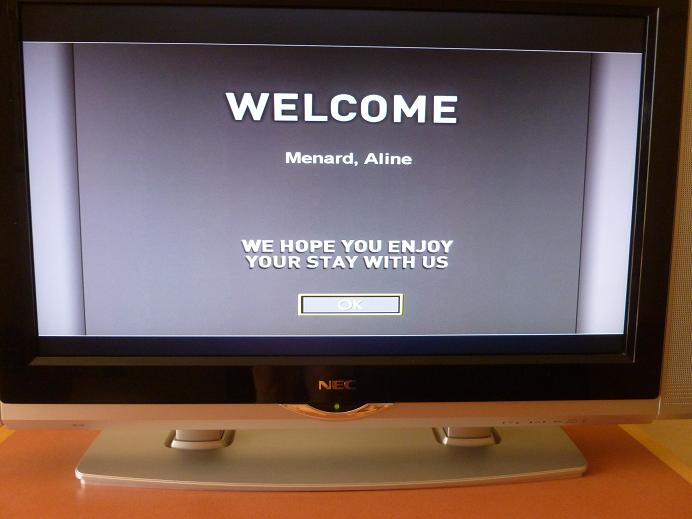
and check out was was showing on the TV in my room ! Now that's a Welcome I have not seen before.
It is very nice, has free wifi in the rooms, a beautiful
pool area but not within walking distance of downtown. They do offer a free shuttle service downtown
three times a day if you book it ahead of time, so that is nice as well.
I just rested today; I badly needed a shower and a nap
and I wanted to read all the tour brochures to make my selection of excursions
while I am here. Dinner at the hotel as
well rather than downtown. The prices
are all very high, nothing under $20 even if it is just a sandwich. Obviously the isolation of Alice Springs
plays a big role since everything has to be shipped in from far away. One of the restaurants, the one I used
tonight, is open to the Casino area and quite noisy. I think I’ll use the Samphire Restaurant
instead next time. Prices of items in
the minibar in my room are also high: $4
for soft drinks or snacks (small chip, chocolate bar, peanuts, etc), $7 for
beer and wine, $10 for the spirit beverages.
I think I’ll do a bit of shopping when I take the shuttle downtown
tomorrow.


